
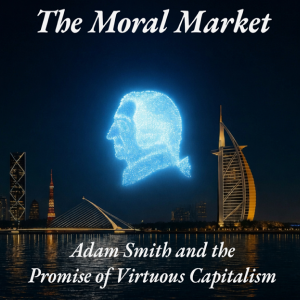
The Moral Market
Patrick Ryan
This audiobook is narrated by a digital voice.
Adam Smith has been misappropriated for two centuries. Invoked as the patron saint of self-interest and unrestrained markets, the real Smith - moral philosopher, civic thinker, and fierce critic of...
Location:
United States
Description:
This audiobook is narrated by a digital voice. Adam Smith has been misappropriated for two centuries. Invoked as the patron saint of self-interest and unrestrained markets, the real Smith - moral philosopher, civic thinker, and fierce critic of monopoly and greed - has been hiding in plain sight. The Moral Market recovers that Smith and puts him to work on the defining challenge of our time: how do we build a capitalism that actually works, not just for shareholders, but for society? Drawing on The Theory of Moral Sentiments and The Wealth of Nations in equal measure, and ranging across Bernard Mandeville, the Scottish Enlightenment, and contemporary governance failures, Patrick Ryan constructs a rigorous and readable case for virtuous capitalism. This is not nostalgia. It is architecture - a framework for markets built on prudence, justice, beneficence, sympathy, and civic purpose. Duration - 14h 20m. Author - Patrick Ryan. Narrator - Digital Voice ElevenLabs E. Published Date - Wednesday, 21 January 2026. Copyright - © 2026 Patrick Ryan ©.
Language:
English
Title
Duration:00:00:13
Author’s Note
Duration:00:03:54
1776
Duration:00:03:07
Introduction: Reclaiming Capitalism
Duration:00:01:10
The Moral Crisis of Capitalism
Duration:00:05:28
The Misuse of Smith
Duration:00:01:43
Capitalism as a Moral Project
Duration:00:02:48
The Moral Market
Duration:00:04:36
Chapter 1: The Birth of Moral Capitalism
Duration:00:05:45
Scotland in Turmoil: Division as Catalyst
Duration:00:08:08
Jacobitism and the Recasting of Identity
Duration:00:08:32
From Crisis to Conversation: The Birth of a Civic Philosophy
Duration:00:05:37
Smith’s Scottish Context: The Soil of a Moral Vision
Duration:00:05:06
Sympathy, Sentiment, and the Moral Imagination
Duration:00:07:22
Markets and Morals: Smith’s Civic Capitalism
Duration:00:03:37
Admiration of the Rich: Smith’s Psychology of Corruption
Duration:00:06:14
Reason, Restraint, and the Role of Institutions
Duration:00:06:19
From Fragmentation to Framework
Duration:00:04:10
Chapter 2: The Education of a Moral Economist
Duration:00:09:49
Beginnings in Kirkcaldy: Humble Origins and an Early Curiosity
Duration:00:05:18
Glasgow and the Influence of Francis Hutcheson
Duration:00:06:53
Oxford: Disillusionment and Independent Study
Duration:00:07:03
Public Lectures and the Chair at Glasgow
Duration:00:07:56
Travels in France: Quesnay, Rousseau, and Enlightenment Exchange
Duration:00:09:11
Return to Kirkcaldy: Writing The Wealth of Nations
Duration:00:07:10
Final Years: Edinburgh, Legacy, and Moral Reflection
Duration:00:06:26
Chapter 3: The Discipline of Sympathy and Exchange
Duration:00:04:05
Moral Philosophy Before Economics
Duration:00:03:22
The Role of Sympathy
Duration:00:07:38
The Impartial Spectator and Moral Conscience
Duration:00:10:09
The Moral Logic of Exchange
Duration:00:03:06
Justice as the Pillar of Society
Duration:00:09:40
The Market Within Moral Bounds
Duration:00:07:02
Moral Sentiment and Political Economy
Duration:00:05:32
Relevance Today: Sympathy in a Fractured Age
Duration:00:07:21
Chapter 4: Wealth, Power, and the Fragility of Justice
Duration:00:07:01
Justice as the Precondition for Prosperity
Duration:00:05:17
The Moral Corruption of Wealth
Duration:00:04:30
Division of Labour and the Fragmentation of Responsibility
Duration:00:08:24
Justice, Inequality, and the Public Good
Duration:00:05:03
The Fragility of Justice in Commercial Societies
Duration:00:04:40
Embedding the Lessons in Modern Governance
Duration:00:04:49
Chapter 5: Slavery, Empire, and the East India Company
Duration:00:04:30
Slavery as a Moral and Economic Failure
Duration:00:13:35
The Imperial Illusion and the East India Company
Duration:00:12:44
Lessons for Modern Governance
Duration:00:06:11
Chapter 6: Two Visions of Capitalism
Duration:00:04:38
Two Men, Two Centuries, Two Economies
Duration:00:08:27
Keynes and the Moral Purpose of Markets
Duration:00:05:48
Friedrich Hayek and the Procedural Market
Duration:00:06:44
From Hayek’s Order to Rand’s Creed
Duration:00:06:06
The Shareholder Value Revolution
Duration:00:07:20
From Creed to Mechanism: The Financialised Inheritance
Duration:00:07:41
Inelastic Markets and the Venture Casino
Duration:00:04:55
The Amoral Market
Duration:00:03:35
The Moral Architecture vs. the Market Machine
Duration:00:10:21
Shareholders, Stakeholders, and the Scope of Duty
Duration:00:05:38
Short-Termism and the Erosion of Prudence
Duration:00:04:38
Freedom, Responsibility, and the Role of the State
Duration:00:04:42
Lessons for the Twenty-First Century
Duration:00:05:09
Chapter 7: The Rise of the Executive Influencer
Duration:00:07:37
From Merchant Prudence to Founder Myth
Duration:00:12:24
The Fertile Ground of Friedmanism
Duration:00:08:49
The AI Hype Cycle
Duration:00:05:57
The Tech Prophets: Doom, Salvation, and Flight
Duration:00:10:40
The Role of Moral Luck
Duration:00:08:24
Boardrooms as Enablers
Duration:00:09:46
Restoring the Moral Architecture
Duration:00:04:33
Chapter 8: The Collapse of Market Constraint
Duration:00:13:06
From Monopoly Merchants to Platform Lords
Duration:00:10:54
Tech Platforms and the Extractive Degradation
Duration:00:12:11
Collapsed Constraints
Duration:00:23:18
Historical Echoes: The East India Company of Data
Duration:00:09:03
The International Governance Gap
Duration:00:06:04
Practical Lessons for Rebuilding Constraints
Duration:00:05:21
From Moral Collapse to Moral Reconstruction
Duration:00:02:49
Chapter 9: The Conditions of Justice and Trust
Duration:00:08:18
The Social Foundations of Trust
Duration:00:14:48
Institutional Decay and the Erosion of Public Trust
Duration:00:15:19
Market Power Without Moral Constraint
Duration:00:11:37
The Cultural Normalisation of Pretence
Duration:00:13:49
The Case for Architecture
Duration:00:01:25
Chapter 10: The Civic Architecture of a Moral Market
Duration:00:05:45
Justice, Trust, and the Architecture of Restraint
Duration:00:09:40
Beyond Performative Morality
Duration:00:04:12
Public Purpose and the Mission-Oriented State
Duration:00:06:54
Comparative Moral Architectures
Duration:00:02:46
The Scholastic and Natural Law Tradition (c. 1250-1650)
Duration:00:03:45
Confucian Ethics and Modern China (c. 500 BCE-present)
Duration:00:06:19
Ubuntu and African Moral Economies (ancient - present)
Duration:00:09:17
Indian Moral Economies (500 BCE-present)
Duration:00:14:30
Islamic Finance and Modern Islamic Institutions (7th century-present)
Duration:00:10:37
Modern Institutional Traditions (20th century-present)
Duration:00:09:30
Five Pillars of Civic Architecture
Duration:00:05:23
Participatory Democracy: Embedding Citizens in Economic Governance
Duration:00:03:59
Active and Capable Government: Reasserting the Public’s Role
Duration:00:04:44
Robust National Regulation: Law as the Architecture of Justice
Duration:00:08:19
Enforceable International Agreements: Closing Global Loopholes
Duration:00:03:53
Sustained Societal Pressure: The Moral Energy of Democratic Life
Duration:00:02:44
Rebuilding Trust: The Moral Currency of Market Society
Duration:00:03:25
From Civic Architecture to Ethical Leadership
Duration:00:02:31
Chapter 11: Ethical Leadership and Institutional Governance
Duration:00:03:32
Smith’s Personal Example
Duration:00:11:24
Smith’s Philosophy of Leadership
Duration:00:03:53
The Modern Challenge to Smith’s Standard
Duration:00:01:31
Mutual Reinforcement of Person and Office
Duration:00:02:39
The Interplay of Ambition and Restraint
Duration:00:02:36
Leadership as a Public Good
Duration:00:02:20
Prudence, Justice, and Benevolence in Leadership
Duration:00:16:49
Institutions as the Forge of Leadership
Duration:00:09:38
The Institutional Context and Incentives
Duration:00:08:57
When Character Fails - Lessons from Ethical Collapse
Duration:00:10:35
Cultivating Ethical Leadership for the Moral Market
Duration:00:10:56
Leadership Imperatives for the 21st Century
Duration:00:11:12
Chapter 12: Building a Post-Scarcity Moral Economy
Duration:00:12:17
Institutions of Abundance: Governance for the Moral Economy
Duration:00:10:12
The Planetary Commons: Global Cooperation in the Age of Abundance
Duration:00:09:12
Virtue, Culture, and the Civic Imagination
Duration:00:12:03
The Moral Market Reclaimed
Duration:00:13:55
Afterword: A Promise To Keep
Duration:00:07:56
Closing Credits
Duration:00:00:09